The Saturn V main F1 engines from Apollo 11 have been recovered from a depth of three miles below the surface of the Atlantic Ocean.
The Saturn V F1 engines were the most powerful rocket engines ever made. Each one produced over 1.5 million pounds of thrust. The five F1 engines on the Saturn V made it the most powerful launch vehicle ever at over 7.5 million pounds of thrust.
Just over forty years ago on May 14, 1973, I was lucky enough to be among the press and dignitaries sitting on the bleachers or standing in front of the turning basin at the Launch Complex 39 Press Site for the last ever Saturn V launch. I was 19 years old.
My best friend’s aunt was a professional photographer. She got each of us a press pass for the launch of the Skylab space station. For a teenage space fan, who had watched every manned launch since Alan Shepard’s first suborbital Mercury launch, this was truly “dying and going to heaven”.
For several days before the launch we got to go on exclusive tours of the launch site. We were able to see Walter Cronkite’s broadcast booth. NASA loaded us up with press packets and thick tomes of specifications. I can not begin to tell you how totally cool this was.
On launch day I was standing near the countdown clock in the picture above.
I was just three miles away from the launch pad. When the engines fired up, the sound of the F1 engines was felt as much as heard. The low base rumbling seemed to reach directly into my chest and vibrate my heart and lungs. As the Saturn V rose into the sky, I could smell the burned kerosene of the exhaust as I felt the waves of warm air wafting over me.
As I read through Dale Carnegie’s How to Win Friends and Influence People, I keep thinking that I must have read it before. I find myself agreeing with everything I read, and realizing that I practice what he preaches. I am not bragging or boasting, merely observing.
One of the chapters deals with happiness and the observation that one can choose to be happy … or not. Just as I have chosen not to worry, I have chosen to be happy. Now lest you think that I am a self-righteous fool who thinks himself to be a saint, let me assure you that I am far from perfect. Coworkers tell me I don’t smile enough. My excuse is that I am just deep in thought usually trying to find a solution to some work-related problem. Even so, I must work on smiling more.
In conclusion, you can choose to be happy. Why not do so?
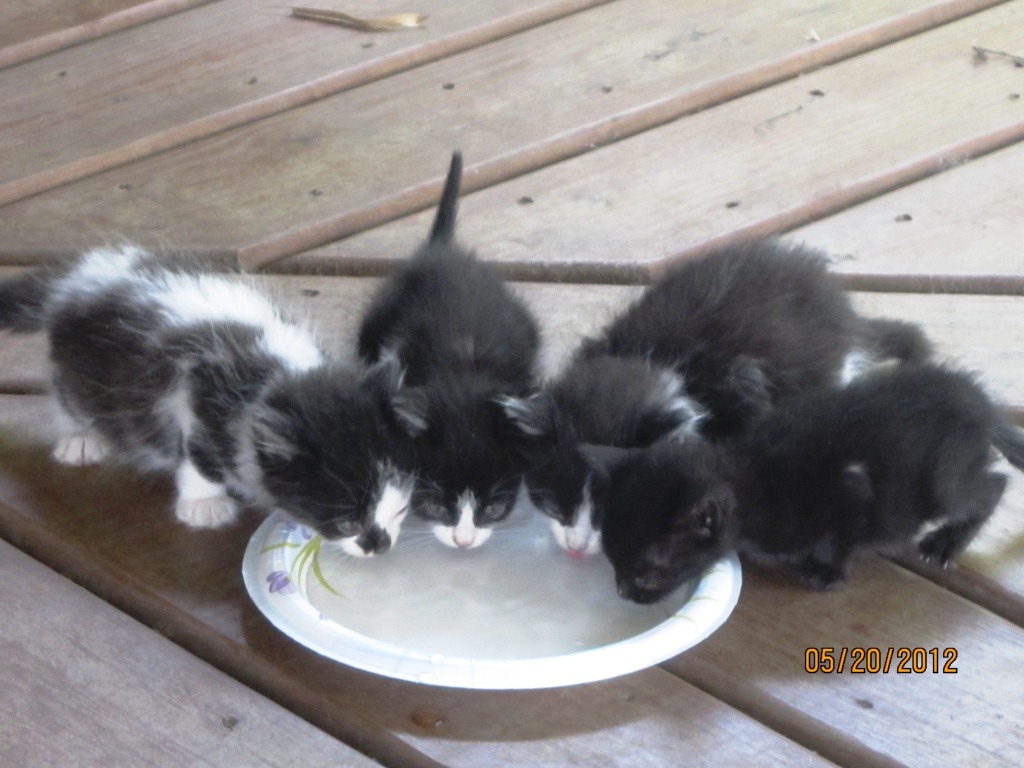
While I continue to read and write, I will leave you with a family portrait of Pickles, Hillary, and their other two siblings before I rescued them. Sadly I only caught Mr. P and Sir Edmund. The other two eventually disappeared.
Pickles is one the left, Hillary is second from the right.
[Author’s note: This post is a continuation of the Welcome to the Future series of essays. If you haven’t read Welcome to the Future, I suggest that you start >> HERE <<]
Wrestling with Worry
I would really like to be able to say, “I vividly remember the night I couldn’t take it any more,” but I can’t. What I do remember is that it was during high school, I was really worried about something, and I was walking over to my best friend’s house thrashing it out in my mind. I was going over and over all of the various scenarios for the outcome of whatever it was I was dreading, and trying to formulate an action plan for each and every contingency. I remember stopping dead in my tracks and thinking … “[expletive deleted] Every time I plan for an outcome it ALWAYS turns out different from what I expected.” There had to be a better way.
From that point on, I vowed to stop worrying. To paraphrase Captain James T. Kirk from the Star Trek episode A Taste of Armageddon, “Worry is instinctive. But the instinct can be fought. I can stop it. I can admit that I am a worrier … but I am not going to worry today. That’s all it takes. Knowing that, I’m not going to worry – today!” I didn’t stop worrying over night, but every time I was tempted to start worrying I told my self “not today.” At some point, without even realizing it, I had stopped worrying. It took a few years, but I no longer worry. Not that I don’t get concerned, upset, or even angry at times (ask my wife). I just don’t worry about things anymore. Worry and fear cause normally rational people to do irrational things. Worry is counter-productive, it clouds the mind and hinders the ability to think clearly. Worry is fear. Fear is the mind killer.
In the ’40s, ’50s, and ’60s, Dale Carnegie reached out to thousands of people with his books and training seminars. His two most popular books were: How to Stop Worrying and Start Living and How to Win Friends and Influence People. They continue to be popular today. My dad was a big fan of Dale Carnegie’s teachings. As a kid in the mid-60s, the last thing I wanted to do was read a bunch of self-help books. As teenager in the late ’60s, I knew better than anyone else and didn’t have the interest in reading self-help books. Instead, as an adult, I had to learn it all on my own. But learn it I did. People are people. We all want basically the same thing. We want to be respected. We want to be acknowledged. We want to be appreciated. We want to be valued. Sometimes a smile and a nod is all it takes. A kind word, and a “Thank you” do wonders.
My dad was always talking to total strangers. It was embarrassing. We went places and he called people by name. Everyone seemed to like my dad. As I grew older I paid more attention to the people around me. I listened more and talked less. I worked hard to learn people’s names and politely kept asking until I remembered. I embarrass my grown sons now when I ask people their names. Yet I go into restaurants and it is like a family reunion. Everyone is glad to see me. Caring enough to learn someone’s name, greeting them by name, thanking them by name means that you respect that person as a unique person – someone of value. Rich, poor, black, white, male, female, Christian, Muslim, Jew, Hindu, American, Russian, Chinese … we all seek respect and good will. Not long ago it dawned on me … “Oh My God I have become my father.”
As part of my research for this essay, I discovered that the Apple iBookstore had both Dale Carnegie’s How to Stop Worrying and Start Living and How to Win Friends and Influence People. I purchased and downloaded them both to my iPad. Better late than never …
[Author’s note: This is the first post of a multi-part essay.]
Growing up in the Space Age
I was born at the dawn of the Space Age. In the span of time from kindergarten to high school, I had a front row seat to mankind’s first steps to the stars. In elementary school we listened to live coverage of Project Mercury – America’s fledgling steps of putting a one-man capsule into space. In junior high we listened as two-man Gemini capsules practiced the rendezvous and docking maneuvers critical to the upcoming Moon missions. In high school, after class, I sat glued to our television as the Apollo astronauts walked on the Moon. Despite the fact that all of these events were televised, we mostly listened to the events as they unfolded, because it wasn’t until the Apollo flights that TV cameras became small enough to carry into space. We didn’t see the spectacular photos that are now so famous until after the astronauts returned to Earth and the photos were displayed in LIFE or National Geographic.
I watched the live broadcast and heard Neil Armstrong’s immortal words “That’s one small step for a man, one giant leap for mankind” as he put the first footprint on the surface of the Moon. I watched as he and Buzz Aldrin read the words on the plaque attached to the leg of the lunar lander. “Here men from the planet Earth first set foot upon the Moon. July 1969 AD. We came in peace for all mankind.” The image was grainy and blurred, but it all unfolded on the TV right in front of me … and it was real … and it was the first time anyone had seen anything like this.
In 1968, a year before Neil and Buzz first frolicked on the Moon, Metro-Goldwyn-Mayer released Stanley Kubrick’s epic 2001 A Space Odyssey. I begged and pleaded with my dad to take me to the Miami showing which debuted in 70mm ultra-widescreen Cinerama – the IMAX of its day. The 142 minute long movie was unique in its realistic depiction of space flight, with ground breaking special effects and a powerful musical score. It was equally unique in its use of long periods of silence to portray the vast distances and length of time required to travel to Jupiter. The original showing even had an intermission. 2001 opened to mixed reviews. My dad and I mirrored the critical and public sentiment. He thought it was long and boring. I thought – and still do – that it was the greatest science-fiction movie ever made. If you have seen 2001 A Space Odyssey you know what I am talking about, if not Wikipedia, the Internet Movie Database, and numerous fan sites do a much better job of describing it than I ever could. If you like science-fiction and have never seen 2001 you really owe it to yourself to see this film.
Recall that in the ’60s and ’70s there was no such thing as VHS tapes, DVDs, or digital downloads. If you wanted to see a movie you either went to the theater to see it, or hoped it would be shown – cut and commercial-filled – on TV. Fortunately 2001 enjoyed frequent returns to theaters after its 1968 release, albeit in 35mm format on a much smaller screen. It enjoyed a cult following in part due to the spectacular light show at the end of the movie, that (I am told) was best enjoyed under the influence of various mind enhancing substances. I saw 2001 A Space Odyssey every time it came back to the theater, often multiple days in a row, often multiple showings in a row. I lost count of the number of times I had seen it after my twenty-second viewing. My dream was to someday be rich enough to have my own home theater and a film copy of 2001 that I could watch whenever I wanted.
Growing up in the Cold War
I was also born at the height of the Cold War. When I was eight years old, the Russians decided to put short-range nuclear missiles in Cuba, four hundred miles away from my home in South Florida. At a cruising speed of six thousand miles per hour, they would take less than four minutes to reach us. I was in the third grade at the time and didn’t fully appreciate the fact that four minutes isn’t a whole lot of time to “Duck and Cover”. I distinctly remember driving with my dad past one of the horse racing tracks that had been commandeered by the military as a staging area for a planned invasion of Cuba. I just thought it was cool to see all the tents and trucks and jeeps and tanks. Only now do I appreciate how scared shitless our parents must have been at the time. Although the storage and launch facilities were built, the missiles had yet to be delivered. For thirteen days in October of 1962 the US and the Soviet Union stood on the brink of nuclear war as the US established and maintained an aerial and naval blockade of Cuba to keep the Russians from delivering the missiles. My eight year old self grasped none of this. I just knew that the Russians were the “bad guys”.
The Russian space missions never got television coverage. Perhaps it was because the Russians were the bad guys or because they spoke a language we didn’t understand or because the Russians never televised their activities. Consequently I never really knew that much about Russian space accomplishments as a kid. As I got older I knew that they beat us into space with both the first satellite and the first cosmonaut. They had the first woman in space and the first space walk. They also seemed to have men and women in space both more frequently and much longer than we had men in space. In many ways the Russians were both better at and more committed to space exploration than we were. Which is why the US was so determined to beat the Russians to the Moon. The manned space race was primarily political and technological, any science was purely incidental.
By high school I was fascinated by the Russians (being the bad guys and all). I discovered that the small local library near our home had a Berlitz “Teach Yourself Russian” book. I spent the summer trying to teach myself Russian. Imagine my excitement when it dawned on me that the “CCCP” so prominent on Russian space suit helmets was actually “SSSR”‘ where the first “S” stood for “Soyuz” (Союз) or “Union.” CCCP stood for USSR. The Russian space capsule first used in 1967, and still used today to ferry cosmonauts and astronauts to the International Space Station, is called Soyuz.
Growing up Geek
Bing Dictionary defines geek (n) as:
1) awkward person: somebody regarded as unattractive and socially awkward
2) obsessive computer user: somebody who is a proud or enthusiastic user of computers or other technology, sometimes to an excessive degree
Roger that. Guilty as charged.
“Awkward and unattractive” I certainly thought I was unattractive. I was also very shy, lacked self confidence and was definitely socially awkward. But I was also smart, interested in science and learning, and probably a bit ADD. I got harassed a lot by the “cool” guys.
“User of computers or other technology” As a kid growing up in the ’60s, I had access to none of this. It didn’t exist. Try to imagine (if you can):
No HD television, no color television; I grew up with black & white TV
No satellite, cable, or digital television; just the standard analog network VHF channels 2 – 13 and the occasional independent UHF channel
No on-demand, no Roku, no Apple TV, no Netflix, no Hulu, no DVR, no DVD, no VHS; you watched what was on at the time or you waited for what you wanted to see to come on
No cell phone cameras, no digital cameras, no webcams, no camcorders; both still and movie cameras used film that needed to be developed before you could see the results
No Internet, satellite, or digital radio, no FM radio; only AM radio
No iTunes, no iPods, no MP3 players, no play lists, no CD players, no cassette decks; I had a record player that played vinyl 33 1/3 RPM Long Play albums or 45 RPM singles
No FaceTime, no Skype, no video conferencing, no iMessage, no instant messaging, no email; you talked on the phone, met in person, or wrote and mailed paper letters
No Facebook, no LinkedIn, no Twitter, no blogs; “networking” involved cocktail parties, golf games, business lunches, and other actual “face time”
No Meeting Place, no WebEx, no GoToMeeting, no Live Meeting; meetings required a physical presence somewhere
No smart phones, no cell phones, no satellite phones, no pagers, no texting, no answering machines; only land-line phones at home and if you needed to make a call away from home there were coin-operated “pay phones”
No Google/Bing/Apple/MapQuest Maps, no Google Earth, no Google Street View, no Waze, no turn-by-turn directions, no car navigation systems, no GPS; we had paper maps
No Google, no Bing, no Yahoo, no YouTube, no Yelp, no Siri; if you wanted to find out about something or how to do something or where something was located, you went to the library to look it up in an encyclopedia, dictionary, atlas, almanac, or other reference book
No Internet, no iPads, no laptop computers, no desktop computers, no graphing calculators, no scientific calculators, no business calculators, no basic “+ – x ÷” four-function calculators; only mechanical adding machines, slide rules, and pencil & paper
None of what we take for granted today existed during my K-12 school years. Yet the science-fiction community gave hints of what was to come. Literature, movies, and TV shows were replete with voice responsive, talking computers and robots. Star Trek debuted in the fall of 1966 when I was in junior high. It presaged video conferencing, data tablets, flip phone communicators, and verbal computers among other modern technologies. Also in 1966, Robert Heinlein’s The Moon is a Harsh Mistress introduced the concept of a sentient networked computer named “Mike”, whose memory and cognitive processes were distributed across various locations in and around the Moon. 2001 A Space Odyssey debuted two years later and depicted the video phone, video tablets, and the quintessential sentient computer, HAL 9000. The technology may not have existed yet when I was a kid, but the ideas did and I wanted all of it. I dreamed of video phones and personal communicators. I dreamed of having my own computer that could answer any question I posed of it. I dreamed of the future.
When I go back and reread the above section I realize that I must come across as one of those grizzled old coots who go on and on about how easy the kids of today have it and how hard it was back in the day. “You durn kids have it too easy today with your microwave ovens and your meals ready to eat and such. Why when I was growing up and we wanted a hot meal, we had to run down a pig on foot and then find us a lava flow to cook it over. Golly Bob Howdy you durn kids just don’t know how easy you’ve got it now.”
I turn sixty later this year and I just don’t feel that old. Yet when you stop to think about it, it is truly mind boggling to realize what has changed in just the last forty years especially when you consider that we put man on the Moon without any of the technology we take for granted today. Sadly, the last footprint was also left on the Moon forty years ago. No one has been back since.
Growing up Scared
As a kid I was scared. My mother was a worrier. She worried about anything and everything. She worried so much she had ulcers (ignoring the fact the no one knew about H. pylori back then). Her worrying rubbed off on me. I identified strongly with Charlie Brown who was the main character of the popular cartoon strip Peanuts by Charles Schultz. Charlie Brown was the poster child for worry. One of my favorite quotes was “I’ve developed a new philosophy… I only dread one day at a time.”
It’s not as if there wasn’t already plenty of stuff for a kid to be scared of. Every year I became more and more aware of the potential for and consequences of nuclear war. I may not have appreciated the Cuban Missile Crisis when it occurred, but by the time junior high rolled around I had a pretty good understanding the dangers of nuclear, chemical, and biological weapons. Then there was the War in Vietnam, which came into our homes every evening at dinner time on the network news. Due to the draft, every male child grew up with the certain knowledge of being sent off to kill or be killed once he finished high school or, if deferred, college. It should be no surprise to anyone if I remind you that Vietnam was an extremely unpopular war. So not only were we treated to nightly scenes of maimed and murdered soldiers, but also nightly scenes of the bloody clashes between riot police and protesters. My entire K-12 TV news experience was filled with, to quote Arlo Guthrie, “blood and gore and guts.” The music scene wasn’t any cheerier. Much of the best music of the late ’60s focused on war and death and anger and sadness. Happy days?
I was a lower-middle income white kid of Norwegian-Italian parents. I lived a sheltered, segregated life with white neighbors and white classmates. I am not sure how it happened – my parents, if alive today, would vehemently deny they were racist – but I developed a fear of black people, Negrophobia. I never knew any black people personally as a kid. All I knew about them was what I saw and heard on the news. Black people were angry. Very angry. They were angry at white people. They were angry at my mom and dad. They were angry at me!
Why were they so angry? According to my parents and the evening news it was because Communist inspired agitators were inciting racial hatred (I didn’t learn the truth until later in life). These Communist agitators had names like Malcolm X, the Black Panthers, Stokely Carmichael, and Martin Luther King, Jr. They were leading marches to Selma, and Birmingham, and Washington D.C. Tens of thousands of angry white-hating black people. To make matters worse there was talk of forced integration. I was going to be put in class with big angry white-hating black kids.
To be fair I was also afraid of big angry geek-hating jocks. I faced the worst of all possible scenarios, being put in class with big angry geek-hating black jocks. Sounds ludicrous doesn’t it. (Not to be confused with Christopher Brian Bridges, whose music and acting I enjoy.) As an adult, I would discover that my childhood fears were baseless and that forced integration was perhaps the best solution to the evil of segregation. Segregation leads to ignorance and ignorance leads to fear. To quote from Frank Herbert’s Dune: “Fear is the mind killer.”
As much as my mother worried about anything, she worried about me. Like everyone else at the time, both of my parents “smoked like chimneys.” Whether I was a premie or just low birth weight, I was small. To make matters worse, I was born with congenital double inguinal hernias (I will spare you the details – that is what the Internet is for). Eventually my intestines became strangulated. I nearly died. I was only a few months old and was one of the youngest and smallest patients to have this kind of corrective surgery. As a result, my parents became overly protective of me. I wasn’t always allowed to do things other kids did. This made me fearful and insecure. I feared failure because I rarely was put in a position to experience it and learn to get over it. I worried about everything. I over analyzed every social situation trying to predict the outcome before I did anything. I was a poster child for “Analysis Paralysis.” Did I mention I was socially awkward?
Despite the fact that my parents love for me caused them to be overly protective, my dad did something equally amazing for me. I have always loved thunderstorms. I love the lightning and I love the thunder. I think that thunderstorms are one of the most exhilarating of all natural phenomenon. There is a reason for this. My dad grew up in an orphanage. It was not uncommon at the time for single mothers who could not care for their children to abandon them at an orphanage. Summertime in Florida produces severe afternoon thunderstorms. The nuns at the orphanage were afraid that lightening would hit the building and set fire to it. Rather than face the possibility of an orphanage full of trapped children burning to the ground, whenever a thunderstorm approached, the nuns would make the children go outside and lie facedown in the grass until the storm passed. Needless to say, my dad was terrified of thunderstorms; shaking, vomiting, fetal position terrified of thunderstorms. Dad swore to himself that I was never going to be afraid of lightning and thunder like he was. From my earliest days my dad would pick me up and bounce me on his knee during storms. “See the lightning,” he would say, “now wait, here it comes … BADDA BOOM.” I would giggle and laugh. He showed no fear, why should I. Of course, I remember none of this. I was too young. But I do know that I love lightning and thunder. Whenever my dad told this story he would add one more thing … by making sure that I was never afraid of thunderstorms he had cured his own fear too.
INTERMISSION
Look around it’s all so clear. Wherever we were going, well we’re here.
So many things I never thought I’d see – happening right in front of me.
Brad Paisley – Welcome to the Future
Even if you have heard this song before, please take few minutes to click on the link above and watch the video. It is a link to the official whitehouse.gov YouTube video of Brad Paisley singing at the White House. Please listen. It is the soundtrack for the rest of this essay.
We’ve been together now for one full week. I honestly can’t believe that I have made it this long. It’s been tough, a lot tougher than you might think. I have a full time job, the one that pays the bills, and I have a lot of responsibilities at home that I won’t burden you with. I have a lot of respect for bloggers who can deliver high quality content on a daily basis.
Let’s face it. This is really a fluff piece. It’s filler. You know it and I know it. I am just posting this to be able to be able to say to myself, “Well you did it, you have a week of blogging under your belt. Congratulations.”
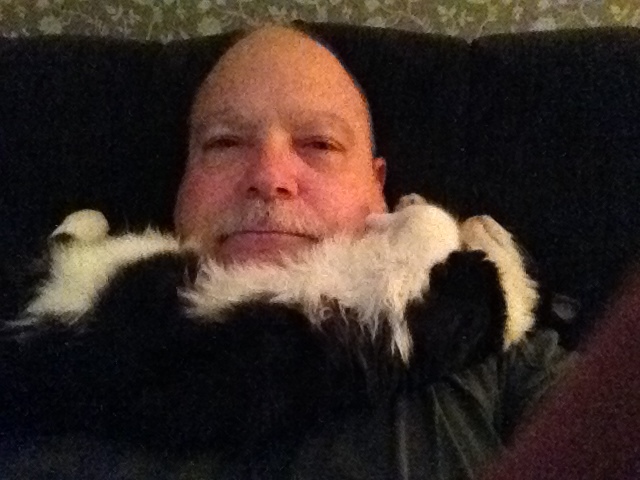
In fairness though, it hard to type around a “cat beard.”
Currently I am working on a longish essay titled Welcome to the Future. I hope to be able to post it by Thursday. I am also starting work on Day 44, which I am targeting for the weekend.
All people, places, and events are fictional … except when they aren’t.
– Day 43 –
The room slowly came into focus. Jessica rolled over on the cot and hit the intercom button. “How long have I been asleep?” Silence. Once again, louder and with more authority. “Yo! … Edward! … How long have I been asleep?”
As I go back and reread my earlier posts, I have discovered that I have a problem with tense. This is particularly true for the HZV storyline. Although I am generally writing it in present tense, there are parts that seem to make the most sense written in past tense. I can’t begin to tell you how many times I have gone back and changed the tense of a passage only to read it again and change it back. This is beginning to make me very tense.
Ralfy is a perfect example of my philosophy that one is not solely defined by his or her profession. If you love Scotch and you have searched the web for Scotch reviews, you know Ralfy.
Never heard of Ralfy? Go ahead. Google Ralfy. I’ll wait. Too lazy? Sigh.
OK then, click >> here <<
Ralfy may be only one of several whisky bloggers, but to my taste he is the most entertaining and credible. He is certainly one of the most prolific and consistent whisky reviewers in the whisky world. Ralfy is a celebrity. I have enjoyed his many YouTube Whisky Reviews. If Ralfy likes it, I know I will like it.
Where am I going with all this, besides of course directing you to an excellent source of whiskey information (for those of you who love whisky)?
As I mentioned previously, every time I re-read one of my posts I see some hitherto unseen typo, punctuation error, or ambiguous phrase. Despite the fact that I obviously missed them the first (second, third, …) time, they now glare at me like a beacon at sea … a beacon on a UFO. A hundred million candle-power Close Encounters of Third Kind UFO beacon.
Like the moth to the flame I am drawn to them, and … they … must … be … fixed.
The upshot of this is that new readers of this blog will read posts that are (hopefully) a bit more polished than what the early readers saw. The downside is that the posts are subtly dynamic. I promise not to significantly change any content.
Update to the Update … My wife (you know who) read through Day 42 and found two major errors I had missed despite multiple readings. Woo hoo, I now have a proof reader!
All people, places, and events are fictional … except when they aren’t.
Day 42 (The Nudist War)
– Day 42 –
“They got it all wrong,” Jessica muttered to herself as she loaded the samples into the DNA sequencer. Safe within the Level 4 Biohazard lab on Galveston Island, Jessica Munroe pushed on for a third sleepless day. “They got it all wrong.” The they in this case was the media, the entertainment industry, the press, anyone and everyone writing about the Zombie Apocalypse. The facts about Zombies had been pretty well established by decades of books, movies, graphic novels, and TV shows. Everyone knew them:
They went by many names: zombies, the undead, walkers, biters, etc.
They could not be killed by normal means – only a direct hit to the head would work, either severing the head entirely or at least destroying it.
Without the de rigueur head shot, a zombie would live forever, regardless of the amount of otherwise traumatic injury it had sustained. A zombie with half its body gone was still a threat.
Zombies were immune to circumstances that would kill the living, such as drowning. Zombies could wander the bottoms of lakes, rivers, and other bodies of water indefinitely, posing an ongoing threat.
Zombies, although chronically hungry, did not eat each other (perhaps out of professional courtesy). Only the warm fresh flesh of the living would suffice.
Zombies were slow and mindless. They shuffle along stumbling after their victims.
Having covered the why and what of Contrafactual, I will now address the who. This turns out to be an interesting dilemma for me. I have always been a very private person, my wife even more so. When I told her about this blog she emphatically insisted “Don’t tell them my name.”
I have never been a big fan of social media. Don’t get me wrong. I just never felt that it was for me personally. Although I have a Twitter account, I could never imagine why anyone would dote on my every activity. So needless to say I don’t post on it. Same for Facebook. I got an account to see what my son was up to. He rarely calls, but he posts daily. It was the best way for me to follow his actities, especially when he was living abroad. Finally there is LinkedIn. Yeah got an account there too, solely for business contacts.
I am not a joiner, never have been. Yet here I am on a mission to write something everyday and submit it to the world for critique. As they say in the spy movies, what I tell you will be on a “need to know” basis. (They also say “I could tell you, but I’d have to kill you.” This would however be a bit extreme in this case.) If your web sleuthing skills are good and you must know all about me I certainly can’t stop you. If and when this blog makes me a rich and famous celebrity, I will deal with the inevitable lack of privacy.
My real name is Christian Bergman, I go by Chris, and often sign emails with cb. I have a day job that pays well, but it is irrelevant in the context of Contrafactual. I have read many times that one’s profession or job does not make the person. I fully subscribe to this. The job does not and should not define the person. I strive to have a life outside of nine-to-five that is distinctly my own.
I have been married to the same woman for over thirty-five years. I have two children: sons. One lives three hours away by car. The other lives at home. I also share my home with four cats. Three of them claim me and/or my wife. The fourth claims my son. Stories and pictures of the cats will be shared in the near future.
Authors I have read and enjoyed over the years:
Richard Dawkins
John Scalzi
Kim Stanley Robinson
Douglas Adams
Michael Crichton
Douglas Hofstadter
Robert Heinlein
Arthur C. Clark
Roger Zelazny
2001 A Space Odyssey (Kubrick / Clark) the movie and the book and Stranger in a Strange Land (Heinlein) were watershed events of my teenage years.
I am a child of the Space Age, who grew up south of the Florida Space Coast. My early memories include the original Mercury Seven launches. I still remember the little Mercury Capsule model that came with my Science Service (now Science News) subscription. Throughout the 1960’s, I watched every mission, fixated on our black and white TV. Later when I was a teenager, my dad took me up to see one of the early Saturn V launches (9?, 10? … the mission not my age). As soon as I had my driver’s license, I drove up to watch the Apollo 16 & 17 launches from a point on the coast eleven miles away. A few years later, a stroke of luck put me at the main press site three miles from the launch pad of the final Saturn V launch (Skylab) … forty years ago. My final trip occurred on summer break from college when I drove up to watch the last Apollo launch, the US half of the US-Russian Apollo-Soyuz Test Project. Even today I continue to follow private and government space programs. I have a keen interest in SpaceX. I also follow most unmanned missions as time permits.
I play chess. I have just discovered Frozen Synapse for iPad. I am excited by the sneak peak of Morning Star Alpha for iPad. I follow the trials and tribulations of Apple with great interest and I even own a few shares of AAPL stock. One of my other fantasies is to become an iPad game developer. Contrafactual is actually written and maintained using a first generation iPad.
I love scotch. I love scotch. Scotchy, scotch, scotch. Single Malt Scotch.
Bruichladdich
Port Charlotte
Octomore
Aberlour A’bunadh
Ardbeg Uigeadail
Laphroaig
Sipping only and not to excess.
Recently watched (all or up-to-date):
Doctor Who
Breaking Bad
The Prisoner (1967)
So, now you have something about me to chew on for a while. Be seeing you …
Every time I reread my initial posts, I find more typos. Not misspelled words, just perfectly valid wrong words. I assure you that I have read and reread each of my posts for spelling and punctuation before posting. Incorrect spelling looks so amateurish. Unfortunately I seem to read what I expect to see and not what is really there.
Even worse there appears to be a disconnect between brain and fingers. I frequently wonder how what I wanted to type turned into what I actually typed. I blame autocorrect. Were these text messages or emails I might be less concerned (although I do strive for accuracy in my emails), but this is alleged to be a literary blog. Please accept my sincere apologies. I will strive to correct this.
One other point, after some deliberation I have decided to eliminate or at least reduce the number of external links. Chances are that since you are reading this, your Google, Bing, Yahoo or other search engine skills are probably pretty good. Feel free to leave a comment if you prefer me to add more external links.
Who, what, where, when, why – the Five Ws. In the previous post I told you why I decided to start this blog. Now, with your indulgence, I would like to tell you what I want accomplish.
I once read an article (sadly I do not recall who wrote it) that discussed the ease with which our minds accept certain contrafactual situations, but not others. For example let’s say that I suggest that you imagine that you are a pilot. Now unless you are a pilot, this would be contrafactual to your state of being. I have made one change only. I am suggesting that instead of imagining yourself as you are, that you imagine yourself as a pilot. Most readers have no problem with this.
Next assume that you are flying a commercial airliner from New York to Amsterdam. Any one who has flown can probably hold this mental image. Even someone who has never flown can probably imagine themselves to be this pilot. Now assume that you (as this pilot) are suddenly in a terrible storm. Visibility is poor, the aircraft rocks violently from side to side, suddenly you hit a severe downdraft and it feels as if the bottom has fallen out of the plane. Are with me so far?
You black out momentarily only to discover that your copilot is now a goat. In great confusion you bolt from the cockpit to discover that your passengers are actually various large fish, dolphins, and the odd whale or two. All happily singing Kumbaya.
At what point did I loose you? Now if I intended to be writing humor, the above passage could be quite humorous – in a Douglas Adams sort of way. In fact Adams used this type of humor to great effect in his writings. But what if I meant to be deadly serious? Well, in that case, I have obviously pushed the envelope too far.
What’s my point? My point is that fiction is a study of the contrafactual. It is a dance wherein the author changes just enough to make it interesting, but not so much that it becomes unpalatable. The readers can easily imagine themselves to be in the position of the protagonist or any of the other characters.
Science fiction pushes the boundaries a bit further. A higher level of contrafactuality is imposed. The worlds of science fiction are not our worlds, but generally the Laws of Physics still apply. Seventy year-old green-skinned human soldiers can be accepted as long as the reader can imagine a possible future where genetic modification makes this possible. If you can’t imagine such kinds of things, then perhaps sci-fi is not for you.
Fantasy pushes the level of contrafactuality even further. Now the Laws of Physics can be bent, broken, or even thrown away entirely. This is a world of pure imagination where the author is free to set the ground rules. Many people love fantasy for just this reason. Me, not so much.
Final we have the Absurd. In this case the author changes too much or just the wrong things. In the case of Douglas Adams it results in good humor – but not everyone can appreciate this. I am sure that there is a non-zero set of folks who find his work to be just plain stupid. I however find it quite entertaining.
The intended focus of this blog is the contrafactual. That is to say – fiction. Yet there is much that I want to talk about that is non-fiction, viewpoint, observations, etc. Sadly, I admit that I chose the name Contrafactual, in part because other, cooler names that I wanted to use were already taken. But make no mistake, I fully intend to explore the contrafactual … so please be patient.
This blog is dedicated to John Scalzi. He is the reason I am writing this and as such deserves some of the blame for what I may soon be inflicting upon you, my dear readers. For those of you who do not know of John Scalzi, I direct you to his blog Whatever and his Wikipedia page. There you will find more info on him than I could ever hope to catalog here.
Scalzi is an accomplished professional writer (by his own account he makes a good living at it). I discovered him via Red Shirts and continued on through the Old Man’s War series. If you like sci-fi you probably already know of him. I highly recommend him. His books and eBooks are available at all of the usual places.
In addition to writing sci-fi and non-fiction, he is one of the web’s earliest bloggers. His blog Whatever has been active since 1998. In it he pretty much writes about whatever he wants (hence the name) – using it as a tool to hone his writing skills. He also offers frequent advice to would-be writers as summarized in his books:
You’re Not Fooling Anyone When You Take Your Laptop to a Coffee Shop: Scalzi on Writing (2007),
Your Hate Mail Will Be Graded: A Decade of Whatever, 1998–2008 (2008),
and the upcoming Mallet of Loving Correction.
I highly recommend these books to anyone considering a career in writing and to anyone else with a sense of humor.
In his writings, Scalzi repeatedly recommends blogging as a way of perfecting one’s writing skills and creating a following. I am taking his advice to heart. Although I have a lucrative day job, I have fantasies of one day becoming a writer. I use the word fantasies because terms like hopes, dreams, plans, etc. are way too concrete. My fantasies of writing do not even include the “paid” part. At this point in time I am curious to know if anything I write is interesting to anyone else. I don’t know if I will have the time or the fortitude to make the time to write on a daily basis. Heck, I am posting this a day late as it is. Be that as it may, I am jumping head-first into the blogosphere. I hope it’s not too cold.


 Contrafactual